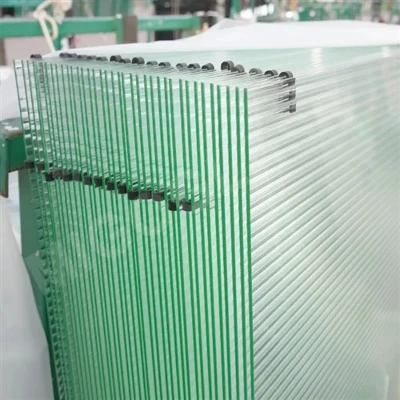
Low iron fluted glass is widely used in modern architectural projects, including interior partitions, glass doors, shower enclosures, and decorative walls. Its ribbed surface provides a distinctive appearance while allowing natural light to enter indoor spaces.
However, when selecting low iron fluted glass for commercial applications, buyers must also consider the appropriate safety glass construction.
Tempered and laminated fluted glass offer different characteristics, and understanding these differences can help architects, contractors, and international glass distributors make better purchasing decisions.
What Is Tempered Low Iron Fluted Glass?
Tempered low iron fluted glass undergoes controlled heating and cooling to improve its mechanical and thermal resistance.
Compared with ordinary annealed glass, properly tempered glass offers increased strength and typically breaks into small fragments when failure occurs.
It is commonly considered for applications such as interior glass doors, shower enclosures, and decorative partitions.
However, tempering compatibility depends on the glass thickness, ribbed surface geometry, and manufacturing capabilities.
What Is Laminated Low Iron Fluted Glass?
Laminated fluted glass combines two or more glass layers using an interlayer material, commonly PVB or another specified interlayer.
When laminated glass breaks, the interlayer helps retain glass fragments and can provide a degree of post-breakage integrity.
This makes laminated configurations relevant to architectural projects where glass retention after breakage is an important design consideration.
The fluted surface orientation and interlayer bonding requirements must be reviewed during product design because not every patterned glass configuration is suitable for the same lamination process.
Key Differences Between Tempered and Laminated Fluted Glass
The main differences involve glass construction, breakage behavior, weight, and installation requirements.
- Tempered fluted glass is a single glass panel that has undergone thermal strengthening. It may be suitable for applications where the approved design calls for monolithic safety glazing.
- Laminated fluted glass consists of multiple glass layers bonded together. It may be preferred where the design requires glass fragment retention or additional functional performance.
Neither option is automatically suitable for every application. Final selection depends on project specifications and applicable safety standards.
How Does Processing Affect Glass Appearance?
Low iron fluted glass is valued for its neutral color and distinctive linear texture.
Additional processing, including tempering or lamination, may influence the finished panel's optical appearance.
For laminated configurations, the interlayer material, glass arrangement, and pattern orientation may affect transparency and visual distortion.
Buyers should request samples when appearance consistency is particularly important.
What Should B2B Buyers Consider?
Before ordering tempered or laminated low iron fluted glass, buyers should confirm:
- Intended application and safety requirements
- Glass thickness and finished dimensions
- Tempered or laminated construction
- Fluted pattern and surface orientation
- Interlayer type and thickness, if applicable
- Edge processing and drilling requirements
- Installation hardware and support conditions
- Applicable standards and inspection criteria
Complete specifications help manufacturers evaluate processing feasibility before production.
Conclusion
Tempered and laminated low iron fluted glass serve different architectural requirements.
Tempered glass provides enhanced mechanical strength and characteristic breakage behavior, while laminated glass offers fragment retention through its interlayer construction.
For international B2B buyers, selecting the correct configuration requires evaluating safety, appearance, processing compatibility, and installation conditions together.
Explore MIGO Low Iron Fluted Glass for customized architectural glass solutions.