Heat-treated glass products, whether heat strengthened or tempered, are produced in a very similar fashion using the same processing equipment. Briefly, the glass is heated to approximately 1200ºF (650ºC) and then force cooled to create surface and/or edge compression in the glass. It is by controlling the rate of cooling that determines if the glass is either heat strengthened or tempered. To produce tempered glass, the cooling is much more rapid, thus creating higher surface and/or edge compression in the glass. To produce heat strengthened glass, the cooling is slower and the resultant compression in the glass is lower than fully tempered glass yet still higher than annealed glass. The industry standard specification requirements for heat strengthened and tempered glass are set forth in ASTM C1048 “Standard Specification for Heat Treated Flat Glass – Kind HS, Kind FT Coated and Uncoated Glass.”
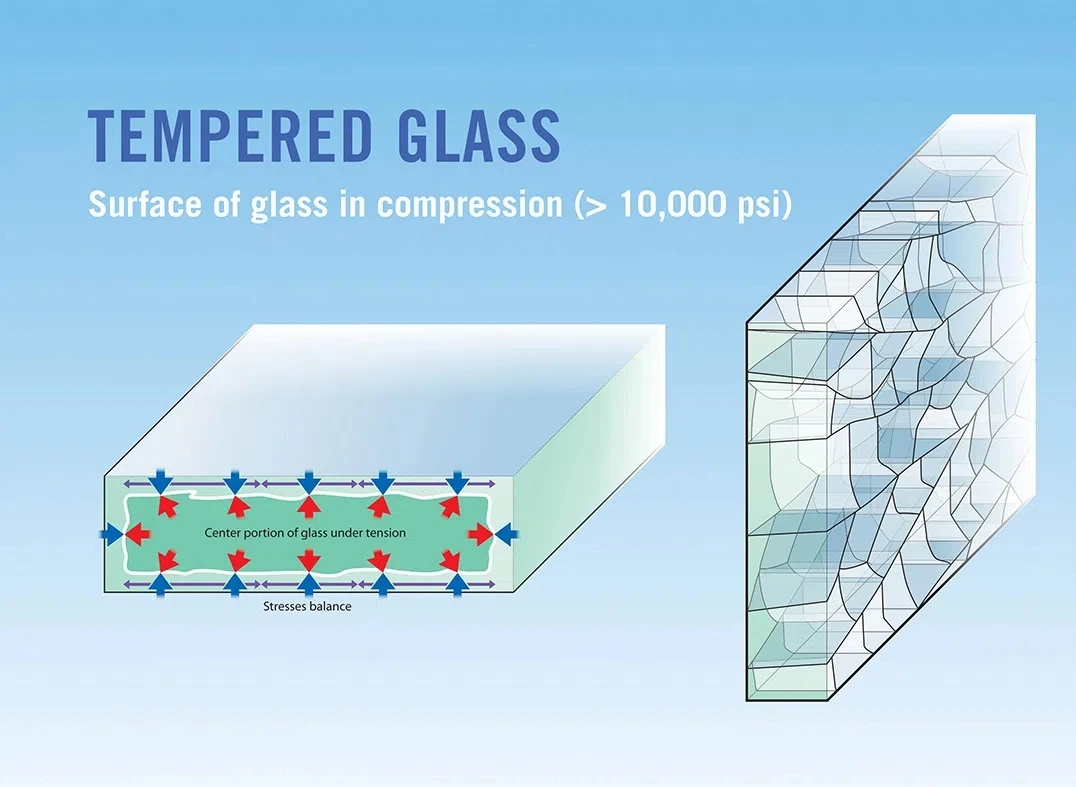
Because of the compression in the glass, heat strengthened glass is approximately twice as strong as annealed glass of the same thickness. Tempered glass is approximately 4 to 5 times as strong as annealed glass of the same thickness. Except for this increase in mechanical strength, all other properties of the glass remain unchanged including glass deflection.
The most dramatic and important difference between heat strengthened and tempered glass is in the post breakage characteristics of the two products (i.e. break pattern). If heat strengthened glass should break, the pieces will be relatively large and tend to remain in the glazing system until removed. Tempered glass, on the other hand, is designed to break into innumerable small, roughly cubical pieces. In fact, it is this break pattern that qualifies tempered glass as a safety glazing material. However, because of the break pattern, tempered glass is much more likely to evacuate the glazing system immediately upon breakage. Responsible design professionals must consider the tendency of tempered glass to evacuate the opening upon breakage and the consequences must be acceptable. Responsible parties know that there is always a possibility of glass breakage; therefore the glass construction must be designed with a low probability of breakage, typically less than 8 panels per 1000 panels, but if the glass does break, the glass design must be done in a manner so that the breakage consequences are acceptable.