White haze reasons and solutions:
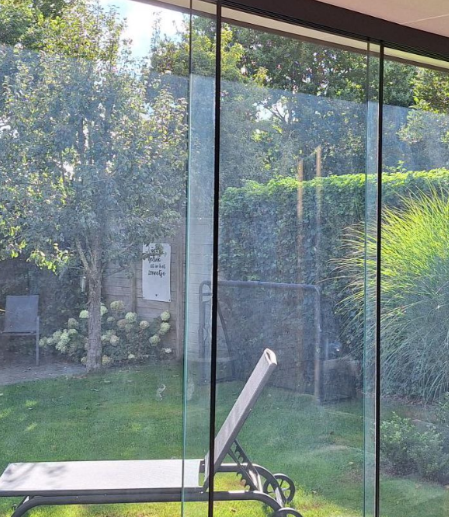
The anti-mold powder on the glass, unclean cleaning, improper operation of the tempering furnace, and poor storage environment may all cause white fog on the glass. The following is an analysis:
1. Anti-mold powder causes white fog
- If the anti-mold powder on the glass is not completely removed during the cleaning process, the residual anti-mold powder will react with moisture and oxygen in the air during subsequent processing and storage. For example, some components in the anti-mold powder may absorb moisture to form tiny water droplets or water films that are slightly moldy, causing the glass surface to appear white fog.
Treatment method: Mix hydrofluoric acid (HF) and water in a ratio of 1:8 (note: more than 1:8 will cause damage to the hands), and wipe the glass. Note: Be sure to do a good job of corrosion protection, and the surface must not be exposed to HF, otherwise it will be severely corroded! After wiping the glass, wipe it again with clean water, and then wipe the glass dry.
2. White fog caused by unclean cleaning
- If impurities such as glass debris and abrasive particles generated during the edge grinding process are not cleaned clean, they will remain on the glass surface. These impurities will change the flatness and finish of the glass surface, causing light to scatter and refract when passing through the glass, resulting in a white fog-like appearance.
- Too much glass powder impurities remain in the water tank of the cleaning machine, resulting in unclean water for cleaning the glass, resulting in some glass dust remaining on the glass and forming white fog.
Treatment method: Clean the water tank of the cleaning machine regularly and use high-quality water to clean the glass.
3. Improper operation of the tempering furnace causes white fog
1. Temperature problem:
- Uneven temperature or improper temperature setting in the tempering furnace is one of the common causes of white fog. If the glass is overheated locally during the heating process, the surface of the glass will deform and stress will be concentrated. When the glass cools, white fog may appear in these stress-concentrated areas. For example, uneven distribution of the heating elements of the tempering furnace and poor airflow in the furnace may lead to uneven temperature.
Treatment method: The parameter settings of the tempering furnace are set separately according to the original films of different thicknesses and different manufacturers.
2. Equipment problems:
- The entire surface of the glass has white fog: The entire surface of the glass has white fog mainly due to the inconsistent speed or level difference of adjacent ceramic rollers. The reasons for the appearance of white fog on the entire surface during production are: the ceramic roller is broken or the ceramic roller bearing is damaged; the drive belt is broken or too loose; the ceramic roller is deformed; the height of the ceramic roller is inconsistent when it is installed; the number of ceramic rollers driven by adjacent motors is inconsistent, resulting in inconsistent ceramic roller speeds.
Solution: Replace the ceramic roller or replace the ceramic roller bearing; reconnect the drive belt; replace the ceramic roller; recalibrate the height of the ceramic roller; change the number of ceramic rollers driven by the motor.
4 . White fog caused by storage environment
- High temperature and high humidity environment is one of the main reasons for glass mold. When the relative humidity in the air is high, moisture will condense on the surface of the glass, providing conditions for the growth of mold. Generally speaking, when the relative humidity exceeds 60%, the risk of glass mold will increase significantly. The temperature is between 20℃ - 30℃, and mold growth is more active. If the glass is stored in a high temperature environment, it will accelerate the growth of mold. For example, in the hot summer, the temperature in a warehouse without good ventilation rises, and the possibility of glass mold increases.
Treatment method: Keep the relative humidity below 50% to reduce the risk of glass mold. For example, place desiccant bags in the warehouse and replace them regularly; install a ventilation system to keep the air flowing. Control the temperature of the storage environment to avoid too high or too low temperatures. Generally speaking, it is more appropriate to control the temperature between 15℃ - 25℃.
In summary, in order to avoid the problem of white fog on glass, it is necessary to strictly control each link of glass production, cleaning, tempering and storage to ensure standardized operation and suitable environment to ensure the quality and transparency of the glass.