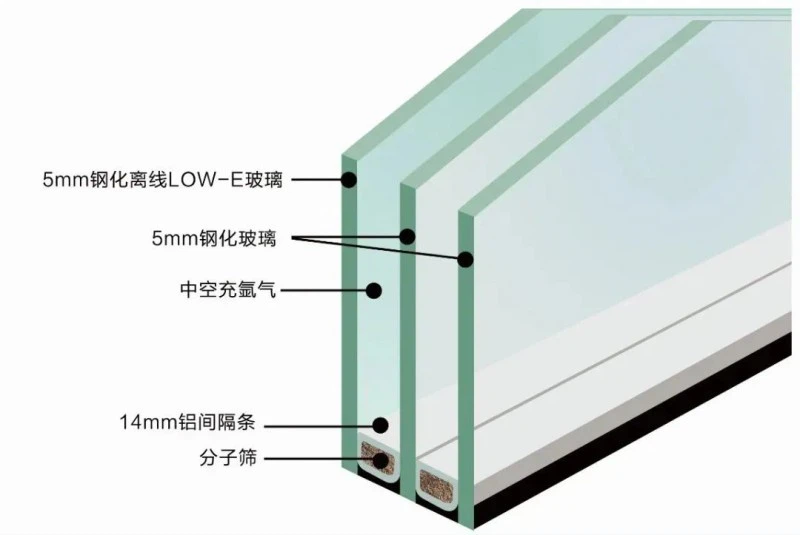
In terms of technology, Low-E glass can be divided into online high-temperature pyrolysis deposition method and offline vacuum magnetic sputtering method.
1) Online high-temperature pyrolysis deposition method
It is done during the float glass cooling process, in which liquid metal or metal powder is sprayed directly onto the surface of the hot glass, and as the glass cools, the metal film layer becomes part of the glass. This kind of glass has a single variety, poor heat reflectivity, and low manufacturing cost. Its only advantage is that it can be bent and tempered. It does not have to be used in a hollow state and can be stored for a long time.
Its disadvantage is that its thermal performance is relatively poor. Unless the film is very thick, its "u" value is only half of that of sputtering "Low-E" coated glass. If you want to improve its thermal performance by increasing the film thickness, then its transparent Sex is very poor.
2) Offline vacuum sputtering method
The off-line method to produce Low-E glass is currently the commonly used vacuum magnetron sputtering coating technology in the world. Different from the high-temperature pyrolysis deposition method, the sputtering method is off-line, and there are horizontal and vertical points according to the different glass transmission positions.
Variety of varieties, excellent heat reflection performance, obvious energy saving characteristics, high, medium and low transmittance products can be produced according to different climate characteristics, and the colors are silver gray, light gray, light blue and colorless and transparent, etc. Glass can also be made in many other colors such as green. The disadvantage is that it cannot be hot bent, and the silver oxide film is very fragile, so it cannot be used like ordinary glass. It must be made into insulating glass, and it is not suitable for long-distance transportation before it is made into a hollow product.