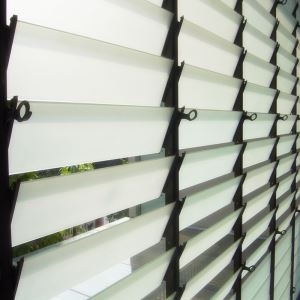
Characteristics of insulating glass
①Greater energy saving effect
High-performance insulating glass, due to a special metal film, can achieve a shielding coefficient of 0.22-0.49, reducing the indoor air conditioning (air conditioning) load. The heat transfer coefficient is 1.4-2.8W (m2.K), which is better than ordinary insulating glass. It is also very effective in reducing indoor heating load. Therefore, the larger the window is opened, the more obvious the energy saving effect will be.
②Improve indoor environment
High-performance insulating glass can intercept considerable energy from the sun into the room, thereby preventing discomfort caused by radiant heat and reducing dazzling caused by sunset sunlight.
③Rich tones and artistry
High-performance insulating glass comes in a variety of colors, and you can choose the color according to your needs to achieve a more ideal artistic effect.
④Usage of high-performance insulating glass
It is suitable for public facilities such as office buildings, exhibition rooms, and libraries, and special buildings that require constant temperature and humidity, such as computer rooms, precision instrument workshops, and chemical factories. In addition, it can also be used in places where sun protection and sunset dazzling are avoided.
Note: Dry air is sealed in the middle of the insulating glass, so the internal air pressure changes according to changes in temperature and air pressure, but only a small deformation occurs on the glass surface. In addition, slight warping may occur during manufacturing, and distortion may also occur during construction. Therefore, including these factors, sometimes there are corresponding changes in reflection, which should be taken seriously. Different colors are chosen, and the reflections are also different.
Gold, copper and silver metal coatings have high reflectivity in the mid-to-far infrared region, that is, when the wavelength range is greater than 4 μm. For example, if the metal coating has a typical thickness, the total reflectivity can reach 90%-95%. High infrared reflectivity is equivalent to low emissivity (Low-e), which will reduce the radiation conversion between the inner and outer glass plates of the insulating glass component. At the same time, Correspondingly, compared with standard insulating glass components with an air layer of 12mm, its thermal insulation value can range from 0.3W/(m2.K). In addition, if the air in the component is replaced by heavy gas, its thermal insulation value is 1.4W/(m2.K). By reducing the thickness of the metal layer, the light transmittance can be increased to about 60%-60%. This extremely thin coating has a very good protective effect on solar energy, while still having high infrared reflectivity values, in the range of 85% or 75%. The air layer is 12mm and is filled with heavy gas in the middle. The thermal insulation value of the coating can reach 1.6-1.9W/(m2.K).

Application of insulating glass
Insulated glass is mainly used in buildings that require heating, air conditioning, noise or condensation prevention, and buildings that require no direct sunlight and special light. It is widely used in residences, restaurants, hotels, office buildings, schools, hospitals, shops and other places where indoor air conditioning is required. It can also be used in doors and windows of trains, cars, ships, freezers, etc.
Insulated glass is mainly used for outer glass decoration. Its optical properties, thermal conductivity and sound insulation coefficient should all comply with national standards. Only insulating glass with reasonable structure and standard design can exert its functions of heat insulation, sound insulation, anti-theft and fire prevention. The use of vacuumed double-layer tempered glass can even reach laboratory standards! There are also insulating glasses on the market that add inert gases and colored pigment gases, as well as adding scenic strips for reinforcement and decoration.
The role of aluminum spacers for insulating glass: Aluminum is called an active metal element, but in the air a dense oxide film will form on its surface, preventing it from interacting with oxygen and water. It can react with oxygen at high temperatures and release a large amount of heat. Using this high heat of reaction, aluminum can replace metals from other oxides (thermite method)

Some Common Insulated Glass types
1. Float insulated glass
2. Tempered insulating glass
3. Coated insulating glass
4. LOW-E insulating glass
Common insulating glass: 5+9A+5 double-layer insulating glass. The 5 here means that the thickness of the glass is 5mm, the 9 means that the hollow part is 9mm, and the letter A is the abbreviation of air. There are also models 5+15A+5, 5+22A+5, 5+27A+5, 5+32A+5, etc. on the market. It is not difficult to understand the meaning of the above.