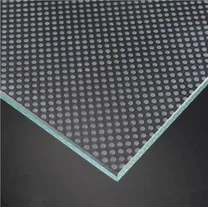
First, AG glass parameters - gloss:
The so-called glossiness indicates the extent to which the surface of the object is close to the mirror surface. The higher the gloss, the closer the glass surface is to the mirror surface. The main purpose of AG glass is to prevent glare, and the main principle of producing anti-glare is diffuse reflection. The main indicator for measuring diffuse reflection is gloss.

Second, AG glass parameters - haze
Haze is the percentage of the transmitted light intensity above the angle of 2.5° from the incident light to the total transmitted light intensity, which is an important parameter for the optical transparency of transparent or translucent materials. The greater the haze means that the gloss of the film as well as the transparency, especially the degree of image formation, is lowered. A cloudy or turbid appearance of the interior or surface of a transparent or translucent material due to light diffusion.

Third, AG glass parameters - transmittance
The ratio of the light that projects and passes through the glass and the projected light as it passes through the glass, we call it the transmittance. Generally, the transmittance has a lot to do with the properties of the substance. The transmittance of AG glass is closely related to the gloss value. The higher the gloss, the higher the transmittance value but the higher the 92%.

Fourth, AG glass parameters - thickness
Thickness refers to the distance between the upper and lower sides of the glass. Refers to the thickness of the object. The symbol "T" is in mm. The thickness of the finished product of AG is based on the thickness requirements of the finished product of the AG. It provides various parameters. Our company evaluates whether it is achieved according to the parameter requirements. After the evaluation, the test piece is also required, and the parameters and thickness are measured to give the correct thickness tolerance.

Five, AG glass parameters - roughness
Roughness (Ra), a mechanical term. In mechanics, roughness refers to the micro-geometric properties of the smaller pitches and peaks and valleys on the machined surface. It is one of the problems of interchangeability research. The surface roughness is generally formed by the processing method used and other factors. The function of the surface of the part is different, and the required surface roughness parameter values are also different. The surface roughness symbol is marked on the part drawing to illustrate the surface characteristics that must be achieved after the surface is finished.
Six, AG glass parameters - particle span
The AG glass span is the diameter of the surface particles after glass etching. We can use the equipment to observe the AG glass particles to see the shape of the particles more intuitively. In addition, the enlarged image of the surface of the AG glass is displayed on the display screen by connecting the display screen, and the size of the particle span is tested by software tools (generally in microns). Unit), through the image to observe whether the particle span of the AG glass surface is uniform.

Seven, AG glass parameters - fresh image
Distinctness of image is also known as image sharpness and projection sharpness. The glass clarity is generally related to the particle span index. The smaller the particle, the lower the span, the larger the pixel density value and the higher the resolution. The surface particle of the AG glass is like a pixel. The finer the more, the higher the definition. .