



Haze indicates the percentage of the perpendicular incoming light that deflects from the straight line at an angle of more than 2.5°. For example, if 60% of the direct light is deflected, this is expressed as a haze percentage of 60%.
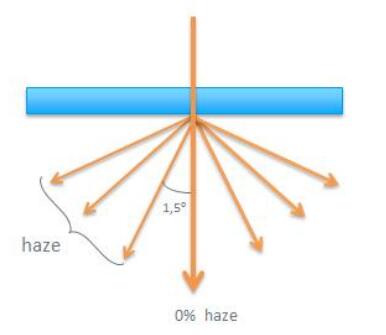
The diffusion of light is indicated by a haze factor. The higher the haze, the greater the diffusion. Blank float glass does not diffuse the light and therefore has a haze factor of 0%. In general, the higher the haze value, the lower the hemispheric light transmission (hem. LT). This means that in the case of a low haze the (hem.) LT is higher than for a high haze. The correct combination of haze value and (hem) LT depends on the crop, the climate and the growing strategy.
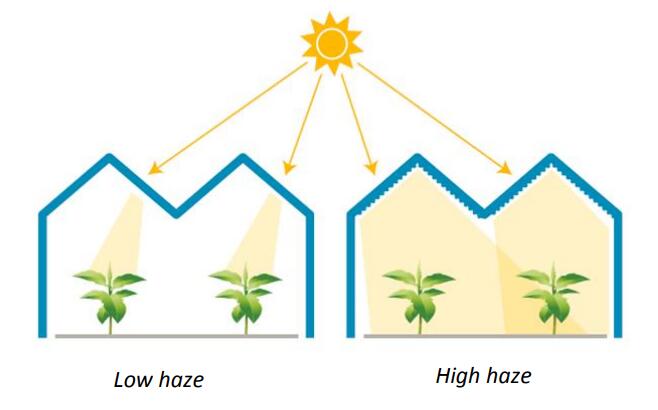
How to know about the haze value of a diffuse glass?
Method 1: By Naked Eyes
We can use a laser pointer to irradiate one side of the glass, and observe the size of the light and shadow area formed by the light passing through the glass and scattering to the wall, so as to have a rough judgment on the haze value of the glass. But this method cannot know the definite value of the haze.
 |
 |
Method 2 Equipment Measurement
The glass is tested with the help of professional equipment to obtain the haze value of the glass. Different types, different thicknesses, and different patterns of diffuse glass have different haze values.
 |
 |
Our company recently purchased a diffuse glass haze tester to facilitate the haze test on different batches of glass samples to ensure the stability, authenticity, and effectiveness of product parameters.