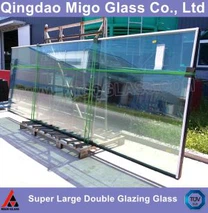
Laminated glass is a composite product made by bonding two or more layers of glass with PVB (Polyvinyl Butyral) interlayer through a high-pressure and high-temperature process. It offers enhanced safety, sound insulation, UV protection, and decorative features compared to traditional monolithic glass.
Product Features
1. Safety Performance: In the event of breakage, laminated glass holds together, preventing the glass shards from scattering and reducing the risk of injury. It can be designed to meet bulletproof and burglar-resistant standards.
2. Sound Insulation: The PVB interlayer effectively impedes the transmission of sound waves, reducing noise transmission.
3. UV Protection: Laminated glass provides high UV blocking capability, preventing indoor furniture, merchandise, and other items from fading and aging.
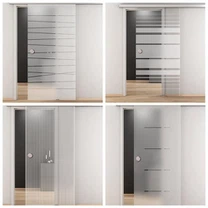
4. Decorative Performance: The PVB interlayer comes in various colors, offering decorative options for the glass.
Specifications:
- Sizes: 2440mm, 2160mm, 1850mm, 1530mm, etc.
- Thickness: 0.38mm, 0.76mm, 1.52mm, 0.55mm.
- Colors: Milky white, blue, dark gray, light green, brown, etc.
- Curvature of laminated glass: Not to exceed 0.3%.
- Wind pressure resistance adjustment coefficient: 0.8.
Questions and Answers:
1. Impact Performance of Different Combinations of Laminated Glass
- Thicker laminated glass structures offer better impact resistance than thinner ones.
- Semi-tempered laminated glass provides better impact resistance compared to regular laminated glass and tempered laminated glass, overcoming the drawbacks of tempered glass spontaneous breakage.
- To enhance the resistance to forced entry, increasing the thickness of the PVB interlayer without changing the total thickness can improve the glass's ability to withstand violence.
2. Prevention of Cracks in Installed Laminated Glass
- The occurrence of cracks in installed laminated glass can be attributed to thermal stress caused by the PVB interlayer absorbing UV and infrared rays from sunlight.
- Preventive measures include thermal stress design and calculations, edge grinding to eliminate microcracks, and minimizing edge and corner damage during production, handling, and installation processes.
3. Protection of Furniture and Merchandise from Fading
Laminated glass protects furniture and merchandise from fading due to the strong UV filtering capability of the PVB interlayer. Both transparent and colored laminated glass can shield valuable items from UV radiation, with a UV blocking rate of up to 99.9%.
4. Delamination Phenomenon and Causes
Delamination occurs when the PVB interlayer separates from the glass due to prolonged exposure of the glass edges to moisture and atmospheric weathering.
5. Boiling Test and Its Purpose
The boiling test involves immersing a laminated glass sample vertically in a water tank at 66±3°C for three minutes, followed by boiling it for two hours. This test evaluates the stability of laminated glass under high-temperature and high-humidity conditions.
6. What are "dry method" and "wet method" in laminated glass production? Which is better and why?
The "dry method" involves sandwiching PVB film between layers of glass and hot-pressing them in a high-pressure autoclave. This method is suitable for industrial production.
The "wet method" involves injecting pre-prepared adhesive slurry into pre-assembled molds of two or more pieces of glass and forming laminated glass through heating polymerization or photo-polymerization. Compared to the wet method, the dry method is better for producing laminated glass due to its suitability for large-scale production, high product strength, minimal optical distortion, and stable quality.
Applications:
Laminated glass finds applications in office buildings, landmark structures, underwater sightseeing tunnels, glass walkways, railings, bulletproof windows for banks, commercial establishments, and more.