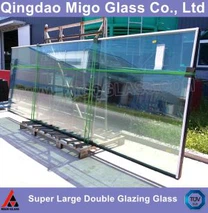
More than 3,000 years ago, when the Phoenicians mixed quartz sand with natural soda, a special furnace melted it into a glass ball. By 1000 D.D., China had also made colorless glass. In the 12th century, the commercial glass appeared and began to become an industrial material. In the 18th century, in order to meet the needs of the development of telescopes, Western Europe produced optical glass. In 1906, the United States made flat glass on board, with the industrialization and scale of glass production, a variety of uses and various properties of glass has come out.

Today, glass, as an important material in the construction industry, is rapidly increasing in use. People's requirements for glass, not only stay in its appearance, wind and cold protection is only its basic function, and glass heat control, cooling costs and internal sunlight projection comfortable balance has become a new theme of technology research and development. As a result, Low-E coated glass stands out as a rising price in the glass family and quickly attracts attention.
What is Low-E glass
The heat lost through doors and windows in a building accounts for about 50% of the heating or cooling energy consumption of the whole building, while the heat lost through glass accounts for about 80% of the heat lost through the entire window, and reducing the heat lost through glass has become an important part of energy conservation in the building. Therefore, building glass with excellent lighting performance and insulation has always been a major research hotspot in the industry, in this industry context, Low-E Glass came into being.
Low-E glass is a low-radiation coated glass, a coating glass with a high reflection ratio to far-infrared light with a wavelength range of 4.5 m to 25 m.
Low-E glass is a member of the coated glass family, its wide application from the 1990s in Europe and the United States developed countries began. In construction applications, the use of Low-E glass can achieve the "warm winter and cool summer" effect, with excellent insulation, insulation performance. Insiders also call it thermostat glass: that is, no matter how much room temperature difference, as long as the Low-E glass, indoor spending very little air-conditioning costs can always maintain a warm winter and summer cool situation.
Classification of Low-E glass
The surface radiation rate of ordinary glass is about 0.84, which means that ordinary glass can return 16% of the sun's far-infrared heat. Depending on the processing process and the Low-E membrane, Low-E glass can be divided into online Low-E glass and offline Low-E glass.
The radiation rate of the online Low-E glass is generally less than 0.25, which means that more than 75% of the far-infrared thermal energy of the sun can be reflected back;
Therefore, Low-E glass has a high reflectivity to an infrared, high transmission rate to visible light, low-E glass with low heat transmission coefficient and excellent shade effect, not only energy saving but also improve the comfort of the building.
Application of Low-E glass
On-line Low-E glass film layer hardness, good mechanical strength, heat processing. However, due to the thick film layer, the color is not flexible, but also relatively single, the radiation rate is generally between 0.15 to 0.25. Offline Low-E glass is a metal film layer and other media film layer, usually a magnetically controlled cathode sputtering method, that is transferred to a coated glass production line by magnetically controlled sputtering. Magnetically controlled cathode sputtering occurs in a stationary electromagnetic field, and electrons accelerate to the glass substation at the anode under the action of Lorenz force, colliding with the atmosphere Ar atoms, and when the energy of the electrons is large enough, the Ar atoms ionize the Ar plus and electrons. The electrons fly to the substrate, the Ar-plus accelerates to the cathode (sputtering target) and bombards the target with high energy, sputtering occurs, the neutral particles in the sputtering particles are deposited on the substrate to form a film, and the secondary electrons in the electromagnetic field under the role of Lorenz force as a pendulum and helix-shaped composite motion. Offline Low-E glass produced by magnetically controlled cathode sputtering has a flexible color and lower radiation rate than online Low-E glass.
Offline Low-E glass products are widely used on building curtain walls and large windows. To meet the dual character of lighting and energy conservation. Generally do not do single-chip use, usually combined into an inflatable hollow glass or vacuum glass use, a hollow cavity filled with Ar or Kr and other inert gases, one is to protect the glass film surface from damage, extend the life of Low-E glass;