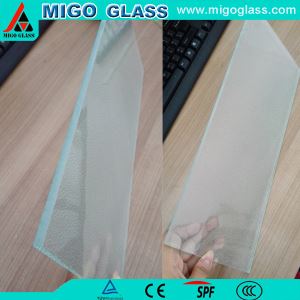
Solar photovoltaic glass adopts low-iron tempered suede glass, the thickness is usually 3.2mm, and the light transmittance is more than 91% in the wavelength range of the solar cell's spectral response (320-1100nm), and it has higher infrared light greater than 1200 nm. Reflectivity. This glass is also resistant to solar ultraviolet radiation, and the light transmittance does not decrease.

The toughened glass used as the encapsulating material of photovoltaic modules has higher requirements for the following performances:
a) Mechanical shock resistance
b) Surface light transmittance
c) curvature
d) Appearance

Tempered glass is a secondary processing product of ordinary float glass. The processing of tempered glass can be divided into physical tempering methods and chemical tempering methods. The strength of tempered glass is several times higher than that of ordinary glass, the bending strength is 3-5 times that of ordinary glass, and the impact strength is 5-10 times that of ordinary glass. It improves strength and safety at the same time. The toughened glass has a large load-bearing capacity, which improves its fragile nature. Even if the toughened glass is damaged, it will appear as small fragments without acute angles, which greatly reduces the damage to the human body. The quenching and heat resistance of toughened glass is 2-3 times higher than that of ordinary glass, and it has obvious effects on preventing thermal cracking. Tempered glass has good thermal stability, can withstand a temperature difference of 3 times that of ordinary glass, and can withstand a temperature difference of 200°C. However, tempered glass can no longer be cut or processed. The glass can only be processed to the required shape before tempering, and then tempered.