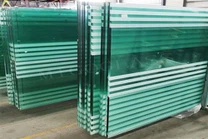
Production of basic glass
Clear flat glass or patterned glass is usually used in greenhouse horticulture. The physical and chemical properties of patterned glass are the same as flat glass, but the optical transmission differs. The main components are also the same, specifically: sand, lime and soda. The two are produced in different ways. Migo diffuse glass is patterned glass and Migo Crystal is flat float glass.
Float glass process
The production of clear float glass is a continuous and fully automated process. The raw materials are automatically mixed and poured into the furnace. In the glass furnace, they are heated up to 1500°C. The ‘cold’ raw materials enter at the front of the furnace and molten glass of around 1100°C flows out onto a tin bath at the back.
The liquid glass flows onto a thin layer of liquid tin via the ‘overflow’ in the tin bath, where it spreads itself and continues to float (hence the name ‘float glass’). The completely flat surface of the molten tin creates a completely flat surface on the underside of the molten glass. The effect of the surface tension in the molten glass ensures that the top of the glass is completely flat. The temperature of the glass reduces gradually to 600°C, after which the glass leaves the tin bath in a solid state. Rollers on the glass edges help to achieve the correct width of the glass sheet. The thickness of the glass is determined by the speed with which the glass is drawn over the tin, among other factors. The glass is then made tension-free through cooling and it leaves the line once it has been cut to a standard dimension of 6,000*3,210 mm.

Manufacture of patterned glass
Manufacture of patterned glass Just like manufacture of float glass, the production of patterned glass is a highly mechanized and automated process. The heating is carried out in the same way, by a number of burners on both sides of the furnace, which alternately heat the glass mass to a temperature of around 1500°C. The molten glass leaves the furnace via two or more production lines. The pattern is printed on the glass by rolling the glass through two rollers, at least one of which carries a pattern. For each pattern, there is a steel roller in which the desired pattern is engraved. The patterned rollers are hollow and are cooled from the inside with water, so that the glass cools to around 700°C. In order to change the pattern, the glass supply must be stopped first by closing the furnace exit. The rollers can then be changed and the furnace exit can be reopened.
With the help of rollers on the glass edges, the glass sheet is guided through the cooling tunnel and the temperature of the glass decreases, so that no tensions can develop in the glass. After leaving the cooling tunnel, the glass is cut to the standard dimensions.