In 1902, the French Le Carbone corporation obtained a patent for coating glass objects with celluloid in order to render them less susceptible to cracking or breaking.
Laminated glass was invented in 1903 by the French chemist Édouard Bénédictus (1878-1930), inspired by a laboratory accident. A glass flask had become coated with the plastic cellulose nitrate and when dropped shattered but did not break into pieces.However, it was not until 1909 that bene- dictus filed a patent, after hearing about a car accident where two women were severely injured by glass debris. In 1911, he formed the Société du Verre Triplex, which fabricated a glass-plastic comp-osite to reduce injuries in car accidents.Production of Triplex glass was slow and painstaking, making it expensive. It was not immediately widely adopted by automobile manufacturers, but laminated gla- ss was widely used in the eyepieces of gas masks during World War I. In 1912, the process was licens -ed to The English Triplex Safety Glass Company. Subsequently, in the United States, both Libbey owe -ns-Ford and Du Pont de Nemours with Pittsburg Plate Glass produced Triplex.
Meanwhile, in 1905, John Crewe Wood, a solicitor in Swindon, Wiltshire, England, patented a lam -inated glass for use as windscreens / windshields. The layers of glass were bonded together by Cana
Canada balsam.In 1906 he founded the Safety Motor Screen Co. to produce and sell his product.
In 1927, the Canadian chemists Howard W. Matheson and Frederick W. Skirrow invented the plastic polyvinyl butyral (PVB).By 1936, United States companies had discovered that laminated "safety glass" consisting of a layer of polyvinyl butyral between two layers of glass would not discolor and was not easily penetrated during accidents. Within five years, the new safety glass had virtually replaced its predecessor.
In the Road Traffic Act of 1930, the British parliament required new cars to use windscreens of "safety glass".

By 1939, some 600,000 square feet (56,000 m2) of "Indestructo" safety glass was being used ever -y year in vehicles produced at the Ford Motor Company works in Dagenham,England." Indestruct -o" safety glass was manufactured by British Indestructo Glass, Ltd. of London.This was the laminated gla -ss used by the Ford Motor Company in 1939, chosen because "it gives the most complete protect -tion. In addition to being splinter-proof, it is crystal clear and permanently non-discolourable."This qu -ote hints at some of the technical issues, problems and concerns that stopped laminated glass from being widely used in automobiles immediately after it was invented.
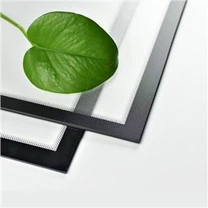
Modern laminated glass is produced by bonding two or more layers of ordinary annealed glass (or tempered glass) together with a plastic interlayer, usually polyvinyl butyral or ethylene-vinyl acetate (EVA). The PVB or the EVA are sandwiched by the glass, which is either passed through a series of roll -ers, or vacuum bagging systems, and ovens, or autoclaves, to expel any air pockets. Then it is heated to form the initial melting. These constructions are then heated under pressure in an autoclave or ove -n, to achieve the final bounded product (fully crosslinked in the case of the thermoset EVA). The tint at the top of some car windshields is in the PVB. Also, colored PET films can be combined with the th -ermoset EVA material, during the laminating process, in order to obtain a colored glass.
Once a thermoset EVA is properly laminated during the process, the glass could be exposed frameless and there will be no water/moisture infiltration, the yellowing index is very low and it shoul-dn't delaminate, due to the high level of bounding (crosslinking).