1. AR Coating Technology
Solar glass plays a critical role in photovoltaic (PV) modules. As the outermost protective layer, it must withstand environmental stressors like wind, sand, and rain while maximizing sunlight transmission to the underlying solar cells. High-quality solar glass typically uses low-iron float glass, with iron content below 0.02%, to minimize light absorption and achieve higher initial transmittance.
However, untreated glass surfaces cause significant energy loss due to reflection. Industry studies indicate that standard solar glass reflects about 4% of incident light. This results in substantial sunlight being bounced back into the atmosphere, reducing overall PV efficiency, particularly in high-irradiance areas.
AR coating (Anti-Reflective Coating) addresses this by depositing nanoscale multilayer films (e.g., silicon dioxide and titanium dioxide) on the glass, using interference to reduce reflection and boost light transmission. Post-coating, transmittance can rise from 91% to over 97%, significantly improving module efficiency.
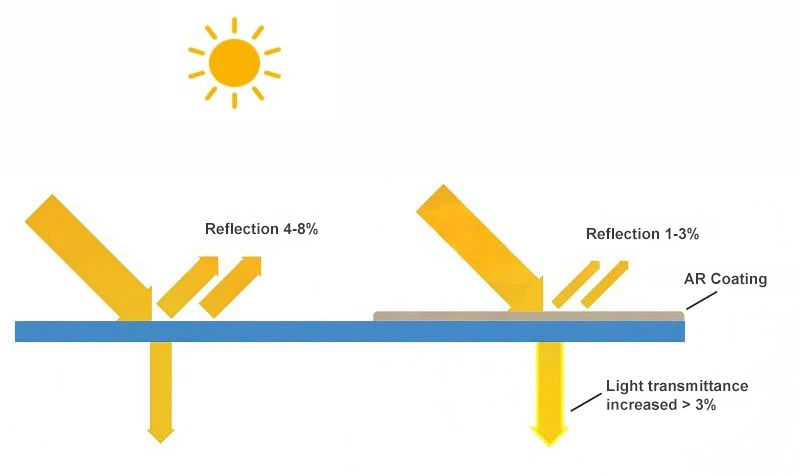
In practical terms, AR-coated solar glass delivers clear benefits. Transmittance gains directly enhance photoelectric conversion, yielding a 2-3% power boost in modules. For a 100MW solar farm, this equates to millions of extra kWh annually. Additionally, the coating improves long-term weather resistance, with reputable manufacturers offering 25-30 year warranties against UV and humidity degradation, lowering maintenance costs. Overall, AR coating is a practical upgrade for better ROI in PV projects.
Product Features:
●Low-iron content,which greatly enhance the transmittance and maximizes the solar thermal conversion efficiency.
●Processed by mano-technology, AR Coating can increase the transmittance by at least 2.0% compared with original glass.
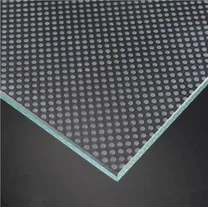
●Patterned glass surface treatment turns specular reflection into diffuse reflection,minimizing light pollution for the environment.
●Tempering processing guarantees the best adhesion between the glass and the coating.
●Chemically-resistant,the coating can resist a wide range of PH in harsh outdoor environments.
●Self-cleaning coating can decompose organic pollutants on the glass surface and refuces maintenance time.
2. Classification and Comparison of AR-Coated Solar Glass
AR-coated solar glass is mainly categorized into single-sided and double-sided coatings, compared across dimensions like coating position, transmittance, applications, cost, and technical complexity. See the table below:
| Comparison Item | Single-Sided Coating | Double-Sided Coating |
|---|---|---|
| Coating Position | Typically on the inner side (cell-facing) | On both sides of the glass |
| Transmittance | Increases to about 94-95% | Increases to 97%+ |
| Applications | Standard single-sided modules, cost-sensitive projects | Bifacial modules, double-glass modules |
| Cost | Lower, ideal for routine large-scale use | Higher, but with superior performance |
| Technical Difficulty | Moderate, simpler process | High, requires precise alignment |
Single-sided coating is often applied to the inner side to protect against external dust. It offers good value, suitable for conventional crystalline silicon modules, balancing transmittance gains with cost for budget-conscious buyers.
Double-sided coating excels in suppressing reflection on both sides, ideal for bifacial modules that capture ground-reflected light, boosting output by 20-30%. It's also suited for double-glass modules, enhancing mechanical strength and fire resistance.
When selecting, consider the application: double-sided for ground-mounted plants to maximize efficiency; single-sided for rooftops to manage costs. Align with overall PV glass needs to meet project goals.
3. Common Quality Issues and Technical Challenges
Common quality issues in AR-coated solar glass fall into optical, physical, and appearance defects. Each is detailed below.
Optical defects include rainbow patterns, interference fringes, and uneven transmittance. Causes stem from uneven film thickness or deposition variations, disrupting light interference. Detection uses spectrophotometers to map transmittance curves across wavelengths. Solutions involve refining vacuum coating parameters, like evaporation rates, to keep thickness variations under 5nm.
Physical defects such as pinholes, scratches, and delamination arise from inadequate substrate cleaning or handling damage. Inspection employs microscopes or automated optical systems (AOI). Remedies include enhanced pre-treatment (e.g., ultrasonic cleaning) and protective layers to achieve adhesion ratings of 5B or better.
Appearance defects like color differences and contamination spots result from impurities or environmental factors. Colorimeters quantify ΔE values for detection. Solutions feature clean room production and batch traceability.
Technical challenges include controlling film thickness uniformity at the nanoscale, using advanced magnetron sputtering. Double-sided coating demands high alignment accuracy to avoid performance drops. Ensuring film integrity post-tempering requires specialized formulations to prevent high-temperature cracks. Maintaining batch consistency in mass production relies on automated systems, targeting transmittance fluctuations below 0.5%. These hurdles can be addressed through ongoing R&D for industry standards.
4. MIGO GLASS Technical Advantages
MIGO GLASS demonstrates strong capabilities in AR-coated solar glass production. With 2 double-sided coating lines-a leading feature in the industry-it handles complex orders efficiently; paired with 2 tempering furnaces for robust product strength. Daily capacity reaches 20,000㎡, equating to about 7.3 million ㎡ annually, exceeding many mid-sized manufacturers.
Quality assurance at MIGO GLASS is rigorous, utilizing precise transmittance testers like the PerkinElmer Lambda 1050 with 0.1% accuracy. Batch consistency standards limit transmittance variance to 0.3%, via in-line monitoring. Inspection flows cover every step: raw material intake checks, pre-coating cleaning verification, post-coating optical tests, and final pre-packaging validation, keeping defect rates under 0.5%.
MIGO GLASS's competitive edges include reliable delivery (15-20 days average), customization (tailoring coatings to client module types), and comprehensive technical support (on-site guidance and optimization consulting). These strengths position MIGO GLASS prominently in the PV glass market.
Please find more information about AR coating solar glass here!!